Why big changes can scramble everyday emotional cues
It can start as something small: you wake up and the room feels unfamiliar, or your phone calendar looks different, and your body reacts before you’ve even had a clear thought. You might feel oddly irritable, wired, or flat—then judge yourself for it, because nothing “bad” happened that morning. But when a move, breakup, job shift, or new caregiving role lands, the usual signals that tell your brain “we’re safe, we’re on track” can get scrambled.
In everyday life, mood is often steadied by routines you barely notice—when you get sunlight, when you eat, how much you move, who you bump into, what time you power down at night. Big changes quietly knock those levers out of alignment. Sleep gets lighter, meals get delayed, caffeine hits harder, and your nervous system can stay on a low simmer. That can make normal stress feel personal, and small decisions feel strangely heavy.
The emotional “message” can look like a personality shift, when it may be routine drift. Restlessness might be your body missing movement. Snapping at people might show up after a week of choppy sleep. Pulling back socially can happen when every interaction takes more effort than usual. None of this is perfectly consistent, which is why it’s easy to misread—but the pattern often makes more sense when you look at what changed around your days, not just what’s happening in your head.
Small predictable anchors that calm a busy nervous system
Sometimes it shows up around 3 p.m.: you realize you’ve been “on” all day, not exactly anxious, just braced. You might reach for another coffee, scroll for a minute, and still feel slightly unsettled—as if your body can’t find the next rung on the ladder.
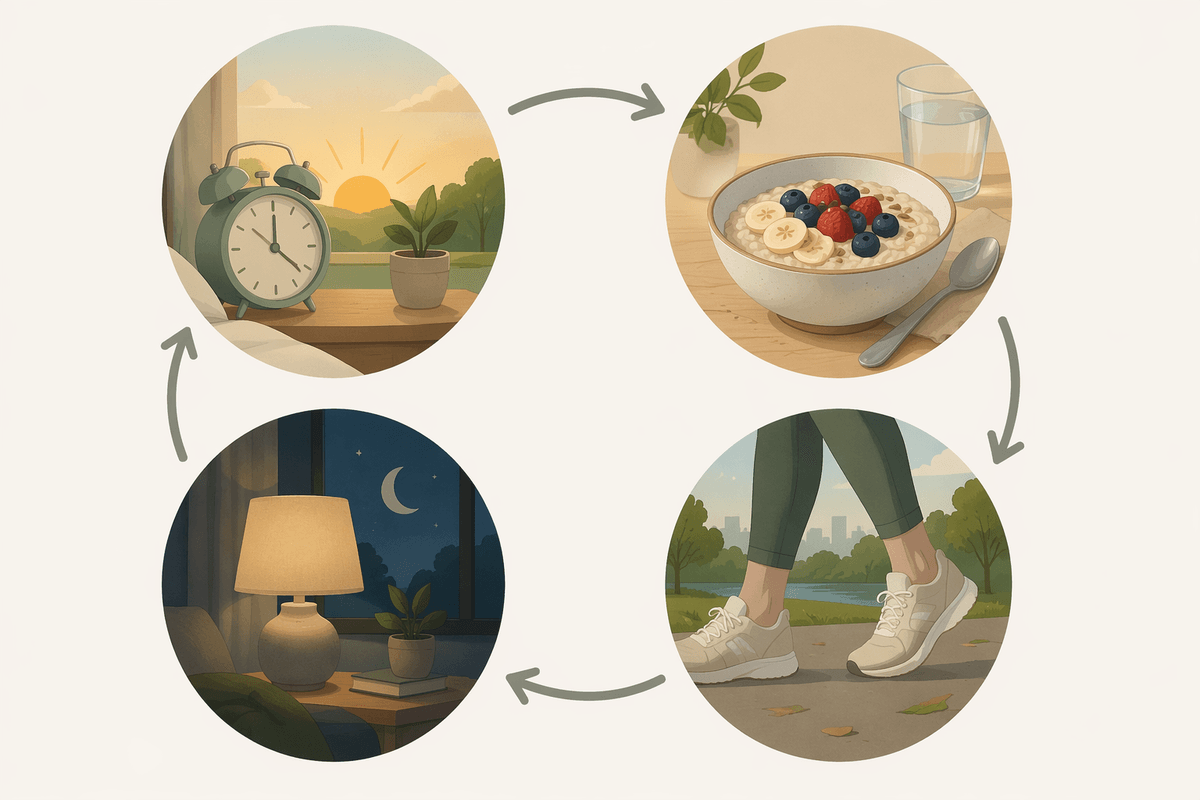
Small anchors work because they give your nervous system a few predictable signals to lean on when everything else is in flux. A consistent wake time, a first meal that happens most days, a brief walk at roughly the same point in the day, a set “lights down” cue—these repeatable beats reduce the amount of internal checking your brain has to do. Less checking often means less background tension.
It’s not always obvious, and it won’t feel perfectly linear. But if irritability spikes after late nights or you feel oddly fragile on days you forget to eat until midafternoon, that’s information. The goal isn’t a flawless routine—just a few steady points that make the day feel more trackable again.
Movement habits that discharge stress without performance pressure
It’s often in the evening that you notice it: your leg won’t stop bouncing, your jaw feels tight, and sitting still makes you feel more restless instead of more “rested.” It can be tempting to label that as anxiety or a bad mood, when it may simply be leftover stress energy with nowhere to go.
Light, non-competitive movement helps because it gives your body a clean outlet—muscles contract, breathing deepens, and the “on” signal can start to taper without needing a breakthrough thought. The point isn’t intensity; it’s discharge. A short walk, a few flights of stairs, gentle stretching while the kettle boils, or a slow bike ride can be enough to change the internal volume.
It won’t hit the same every day. Some days it feels pointless, other days it’s the first thing that makes you feel like yourself again—especially when it happens before you’re fully wound up.
Food, and caffeine, as mood-amplifiers in disguise

You notice it when the coffee wears off: a little tremor in your hands, a thin patience, a sudden sense that everything is more urgent than it needs to be. Or you finally eat something and feel your shoulders drop—then wonder why you were so reactive an hour ago.
Food and caffeine can act like quiet mood amplifiers during a big change, mostly because timing and tolerance shift. Skipped meals can let blood sugar dip, which may read as irritability, fog, or that “I can’t deal with one more thing” feeling. Caffeine can temporarily cover that dip, then leave you more keyed up later, especially if sleep has been lighter or your first meal keeps sliding later.
It’s easy to misinterpret the swing as an emotional issue when it’s partly chemistry plus schedule. If you’re tracking anything, it can help to notice the simple pairings: coffee without food, long gaps between meals, and late-day caffeine on nights when your mind won’t quite power down.
Social contact routines that reduce loneliness without overload
It can hit in the quiet gap between tasks: you reach for your phone to text someone, then stop, because even a simple back-and-forth feels like work. After a big change, social energy often gets less predictable. You may crave contact and still feel overloaded by plans, long calls, or group chats that demand quick emotional responses.
Part of the strain is that casual “micro-connection” disappears without you noticing—coworker hallway talk, familiar neighbors, the barista who says your name. Those small interactions act like nervous-system proof that you’re still part of something. When they drop out, your brain can compensate by scanning harder for reassurance, which can make loneliness feel sharper and socializing feel higher-stakes.
Routines help most when they’re low-pressure and repeatable: a short check-in at a set time, a weekly walk with one person, a few minutes of friendly conversation in a predictable place. It won’t feel consistent, and some days you’ll want to cancel—often that’s the signal to keep it small, not to disappear.
When distraction helps, and when it prolongs stuckness
It usually starts as a “quick break”: you open a tab, check a feed, start a show—and later you realize your body feels even more buzzy, like you never fully landed anywhere. Distraction can be a relief in the moment, especially when the day has been full of decisions and your brain wants something that asks nothing back.
In some situations, it genuinely helps because it interrupts a rising stress loop long enough for your system to settle. But it can also keep you stuck when it becomes the only off-switch, used automatically whenever discomfort shows up. Then the mind never gets a chance to finish processing small signals like hunger, fatigue, or loneliness; it just skips over them.
A clue is what happens right after. If you return feeling a little more present, distraction did its job. If you come back scattered, behind, or oddly numb, it may be adding noise—especially late at night, when bright screens and rapid switching can make it harder to downshift into sleep.
Tracking feelings lightly to notice patterns over time
Somewhere around the third “Why am I like this today?” you may start wanting a cleaner answer. The problem is that memory edits fast: a rough morning can tint the whole day, and a decent evening can make you forget how scattered you felt at lunch. So you end up arguing with yourself instead of noticing what reliably tips you.
Light tracking works best when it’s almost boring. A quick note once or twice a day—sleep quality, first meal time, caffeine, movement, one social touchpoint, and a simple mood word—can reveal patterns without turning your feelings into a project. Over a couple of weeks, the same links often repeat: irritability after late screens, flatness after skipped meals, restlessness on low-movement days.
It won’t be consistent, and that’s part of the point. You’re not trying to “catch” yourself; you’re trying to see routine drift early, before it feels like a personal flaw.