Booking direct in Greece isn’t hard—it’s choosing the right channel.
At 11:47 p.m., I’m staring at a hotel’s one-page website that still says “Best viewed on desktop,” with a contact form that won’t send on mobile. I hesitate with my thumb over “Book on Booking.com,” because it’s the fast, confirmed click. The catch is that the room I actually want (upper floor, sea-side) often shows up only when you talk to the property.
Direct booking in Greece usually isn’t a technical problem; it’s a channel problem. For small, family-run places, email and WhatsApp tend to beat web forms, while a quick phone call can beat both when you’re booking inside a week and ferries are already dictating your check-in time. OTAs give you instant confirmation and familiar cancellation rules, but direct often gets you a better room assignment, a softer deposit, or breakfast thrown in—if you can get a clear reply. This works best for a mid-budget couple with some flexibility on dates; it’s frustrating if you need a same-night answer for a tight island hop.
My default: send one tight message (dates, room type, arrival time, “please confirm total price + cancellation in writing”), then set a timer for 24 hours. If nothing lands, I book an OTA refundable rate as a backstop and keep negotiating direct without panic.
Find legit small hotels fast
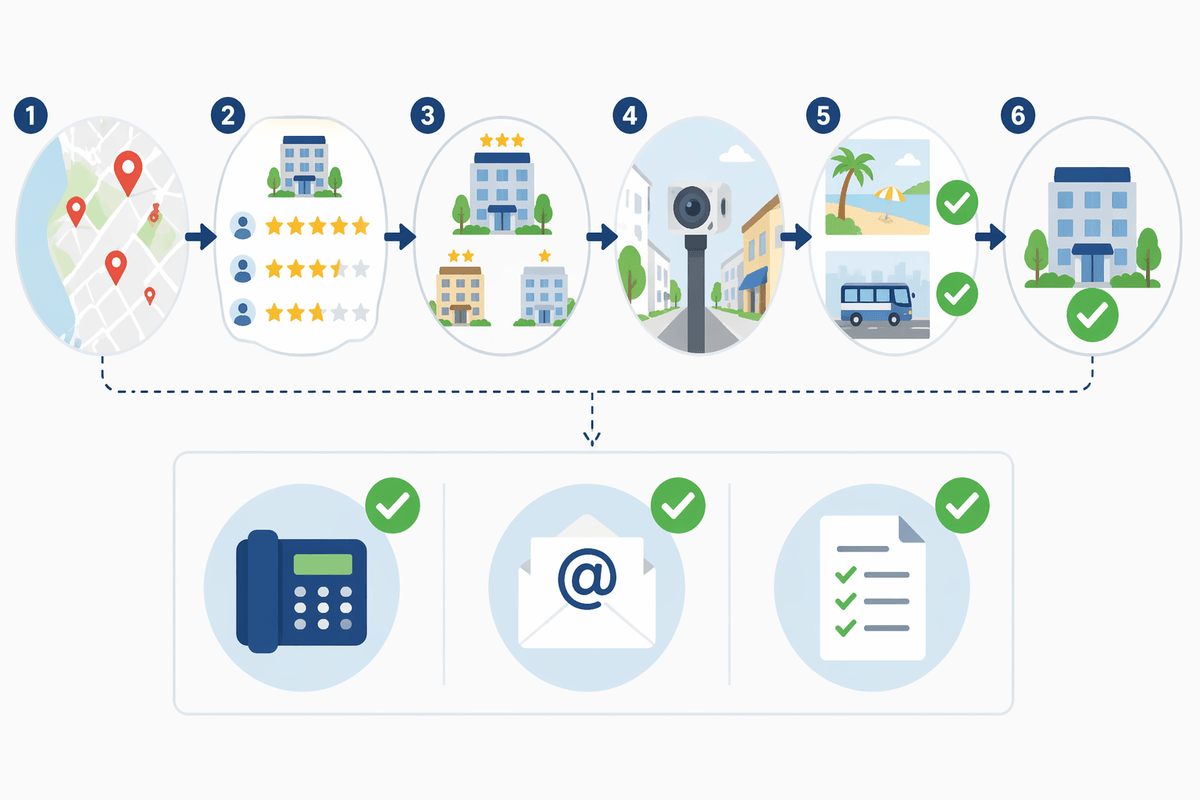
On Santorini, I once dropped a pin “five minutes from the caldera” and watched the walking time jump to twenty-two because the lane turned into stairs halfway down. With a ferry landing at 6:10 p.m. and two carry-ons, that was the moment I stopped trusting listings that only show pretty angles. The goal isn’t to find the “best” small hotel; it’s to find three or four that are real, correctly located, and reachable for your check-in window.
Start broad on an OTA or Google Maps, but use them like a filter, not the finish line: pick a neighborhood first (close to the port if you’re arriving late, or walkable town if you’ll be out every night), then shortlist 6–10 small properties with recent reviews that mention the same owner name, breakfast, and room photos. Cross-check the address on Street View or guest photos; if the “beach” is actually a bus ride, you’ll feel it at 2 p.m. heat. This method works for mid-budget couples; it’s slower if you’re trying to optimize every €5.
Then do a quick legitimacy sweep before you message: look for a working landline, a consistent email domain (even a basic one), and clear policy text somewhere (website, OTA, or a PDF). If you see only a contact form and zero cancellation language, treat it as a time risk—keep it on the list, but pair it with a refundable backstop until you get terms in writing.
Pick the best direct booking method
At 8:06 a.m., I’m in a bakery line in Naxos with flaky sugar on my fingers, trying to copy a hotel email address off a faded sign because the website’s SSL warning won’t let the page load. I pause, because the OTA button would be instant, but I also know the owner is more likely to hold the quieter room if I reach them directly. The concrete problem isn’t “how to book”—it’s picking the one channel that gets a real answer before your ferry times box you in.
If the property has a proper booking engine (not just a form), use it only when the rate rules are clearly written and you can screenshot the cancellation terms. Otherwise, email is the most reliable paper trail: send one message with dates, exact room preference, arrival time (tied to your ferry), and one line that forces clarity: “Please confirm total price (all taxes), deposit amount, and cancellation deadline.” WhatsApp is faster for back-and-forth—great if you’re choosing between two rooms—but I treat it like a negotiation tool, then ask them to restate the final deal by email so you’re not digging through chat bubbles later.
Phone calls work when timing is tight (inside 72 hours, or during peak season when inboxes lag), but they’re the worst for policy ambiguity. If you do call, ask them to email the same details while you’re on the line. For payment, a small card deposit is normal; avoid bank transfers unless you’re comfortable with the risk and the property looks rock-solid. If replies stay vague after one follow-up, that’s your cue to book a refundable OTA rate and keep the direct option alive without gambling the trip.
Ask for the rate you actually want

At 6:32 p.m., my ferry ETA to Paros has already slipped twenty minutes, and I’m staring at an email that says “Double Room, €140” with nothing else—no breakfast note, no taxes, no cancellation line. I hover over reply, because I don’t want to sound like I’m haggling for sport, but I also don’t want to pay a “surprise” €12 municipal tax at check-out. This is the awkward middle: you’re close to a good direct deal, but only if you ask for the exact rate you mean.
I don’t ask, “Can you do better?”—it invites a vague answer. I ask for a specific outcome tied to something reasonable: “If we book direct for 3 nights (July 18–21), could you offer the same price as your refundable rate on Booking.com, or a small direct discount? We’d prefer the upper-floor sea-side room; happy with breakfast excluded if that helps the rate.” That framing gives them trade-offs they can actually say yes to: room position vs breakfast, non-refundable vs refundable, or a slightly higher price with a softer cancellation deadline. It works best for mid-budget couples who care about charm and location; it’s weaker leverage on one-night peak Saturdays or when you’re asking for the only family room left.
Then I pin it down in writing before paying anything: “Please confirm total price for both guests (including all taxes/fees), deposit amount and how it’s charged, and the cancellation deadline/time zone.” If they counter with a non-refundable discount, I’ll take it only when my ferry routing is stable; island hops punish rigidity. If the reply stays fuzzy after one clarification, I stop negotiating and use a refundable OTA as insurance—because the best rate isn’t the cheapest number, it’s the one you can actually rely on when plans wobble.
What I’d do for a first trip
At 9:18 p.m., with ferry tabs still open, I’d stop scrolling after the sixth “charming” listing and pick two base islands for the 10 days. The concrete move: lock in the first two nights near your arrival port (or the airport on Santorini/Mykonos), even if it’s not the dream room, because late arrivals punish long transfers and steep lanes. It’s a trade-off—slightly less romance up front for a calmer start and fewer “we missed check-in” messages.
Then I’d shortlist 6–8 small hotels total (2–3 per island), and message all of them the same hour so replies land in a comparable window. Email for the paper trail, WhatsApp only to clarify room details and send photos; once we agree, I’d ask them to restate the final price, deposit method, and cancellation deadline by email before I pay anything. If a property can’t answer those three points clearly, I’d book a refundable OTA rate as the safety net and keep looking—time is your real budget.
For payment, I’d accept a small card deposit, skip bank transfers unless the place is extremely established, and screenshot the terms the moment they arrive. If you’re the kind of couple that loses patience fast, lean heavier on OTAs for one stop; if you’re happy to do two rounds of messages, direct will usually reward you with the better room.